
Local Visibility Scorecard
How we judge local visibility
The Local Visibility Scorecard is the public framework behind the discovery view of the Revenue Leak Review. It shows whether a home-service business is visible across Search, Maps, AI answers, competitors, and external authority — and separates verified visibility gaps from questions only the owner can answer.
THE SHORT ANSWER
Local visibility is not one ranking. A customer may search Google, open Maps, ask an AI assistant, or compare a few names. The scorecard measures whether the business appears across those surfaces, how consistently, and against the businesses actually competing for the same work. It scores only what public evidence can show. Everything else becomes an owner-data question.
The three visibility gaps that cost the most jobs
Most local audits count keywords. These are the three gaps that change whether a customer can find the business at all:
- They can’t find you where the demand is. The business is absent from the Local Pack, Maps, or ordinary search results for the services it sells.
- You’re visible in one place, not across the market. A strong pin near the shop can hide weak coverage across the service area, and one strong service can hide the rest of the business.
- The recommendation surfaces don’t corroborate you. AI answers and external sources mention competitors more often, or cite sources the business is not part of.
The full framework covers seven weighted categories and 52 checks. Read the discovery framework for the complete map.
What it measures
| Category | Weight | Question |
|---|---|---|
| Intent & Demand Coverage | 15 | Across the commercially meaningful things customers search for, how broadly is the business visible? |
| Maps & Local Pack Visibility | 25 | How consistently does it appear in Google’s local-business results throughout the market? |
| Organic Search Visibility | 15 | How well does it appear in ordinary search results for commercially relevant local intent? |
| AI & Generative Visibility | 20 | When customers ask AI systems for a recommendation, how often and how credibly does it appear? |
| Competitive Share of Visibility | 10 | Relative to the businesses competing for the same demand, what share of discovery does it earn? |
| Authority & Entity Footprint | 10 | How strongly is it corroborated across external sources that support discovery and recommendation? |
| Visibility Resilience | 5 | Is discoverability diversified, or does it depend on one fragile source? |
Maps and the Local Pack receive the highest weight because local-business results are the densest discovery surface for a home-service business. AI receives the second-highest weight because AI answers are now a real recommendation surface. Only validated surfaces contribute, and the public score never treats a brand search as proof of non-branded discovery.
What you get
- A 0–100 score across seven weighted categories, with N/A checks removed from the denominator.
- A one-page report with the three biggest visibility gaps.
- The evidence for each gap, labeled verified, strong signal, or owner data required.
- A service-by-surface matrix: Maps, organic search, AI answers, and the opportunity.
- A geo-grid summary and an AI surface breakdown in the full report.
- The owner-data questions public evidence cannot answer — search clicks, qualified leads, AI referrals, and revenue.
- A machine-readable audit and a verification record for teams that need the detail.
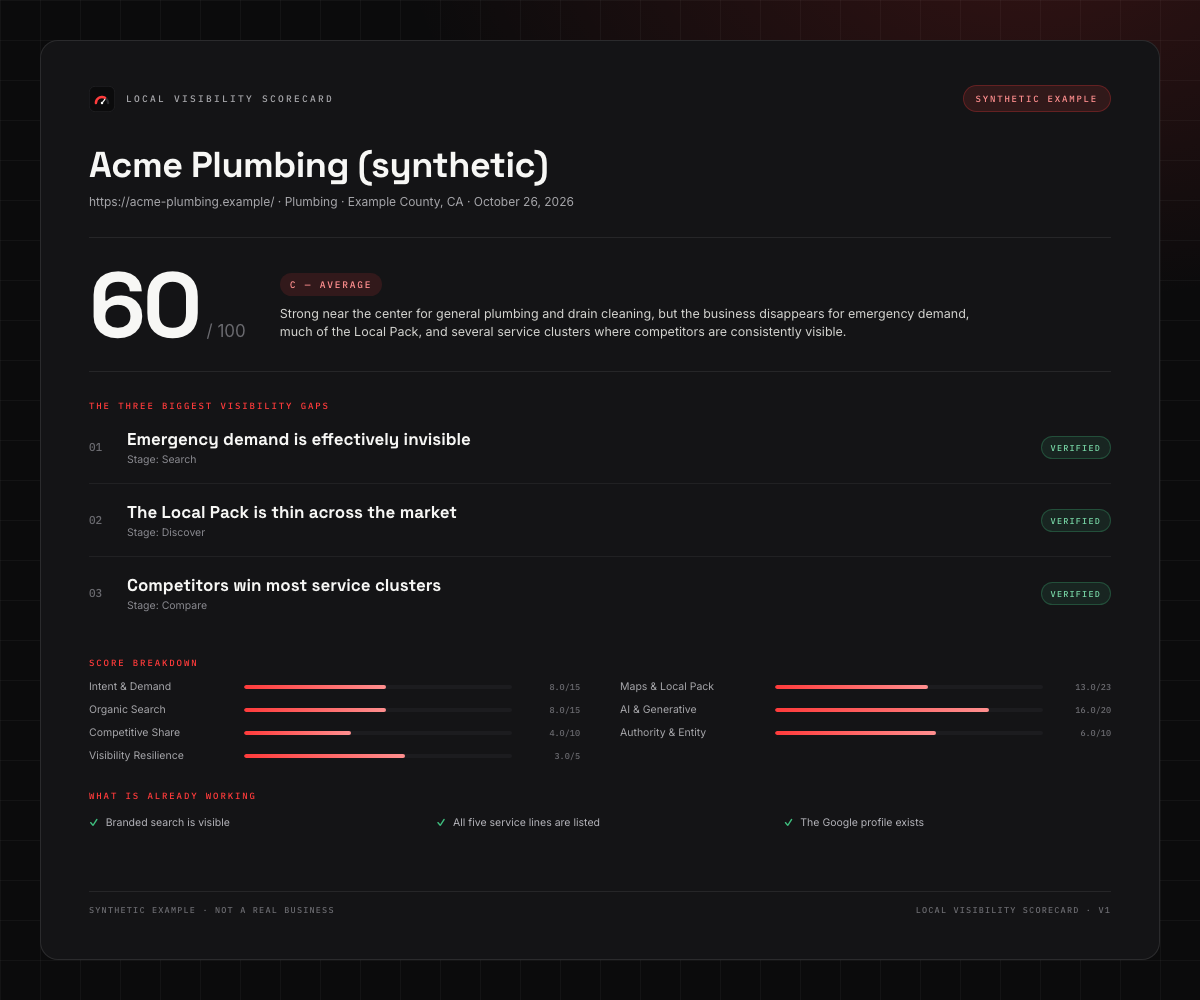
See the full sample report (PDF)
Two ways to use it
Done for you
Have us run it
Request the free Revenue Leak Review. We review the public evidence, name the visibility gaps, and send a private Revenue Leak Scorecard for your business.
Get the free Review
For developers
Run it yourself
The scoring rules, evidence rules, and code are public. Open the project on GitHub and produce the same report.
View on GitHub
What it won’t do
- It won’t score the Google Business Profile’s categories, services, reviews, or action paths. That is the GBP Scorecard’s job.
- It won’t score website speed, mobile forms, or the on-site conversion path. That is the Website Scorecard’s job.
- It won’t treat a directory or publisher as a local contractor competitor.
- It won’t promise rankings, leads, jobs, or revenue.
- It won’t publish a client’s private query set, market geometry, prompts, or report.
Why we made it public
A visibility score is only useful if you can inspect how it was produced. The 52 checks, the evidence states, the locked query universe, and the verification rules are public, so you can see how a finding is judged instead of trusting a black box. Use it to check our work — or to run the review yourself.
Discovery is only one part of the journey. Read how we judge a Google Business Profile for the trust-and-action side, and how we judge a contractor website for the owned-site side. The three scores stay separate on purpose.
We publish client results only when they are measured and the client approves them. See the Results page.
Related: Free Revenue Leak Review · How It Works · Website Scorecard · GBP Scorecard · Market Intelligence · Results · FAQ
Want your own visibility gaps named?
The Revenue Leak Review turns this into a plan for your business.
See the sample report (PDF) · View the project on GitHub · Read the docs